Tips for onboarding your VA
Every seller’s business is different. It will take time for your new VA to learn your unique workflows.
It’s easy to get overwhelmed thinking about bringing a new VA onboard - for many sellers, it will be their first employee.
Fortunately, managing people is a skill you can learn.
The main things to remember are:
provide structure so they feel secure: follow a work schedule and be consistent with paydays
avoid overwhelming them: train them on 1 or 2 new tasks at a time
be responsive: be around while they are working so you can answer questions promptly
get to know them: periodically show interest in their personal life
The #1 reason sellers delay hiring a VA is worries that onboarding will be complicated and time consuming.
It doesn’t have to be.
If you have a quality VA, things will be easier than you think and you’ll soon be wondering how you ever managed without them.
1 week before your VA starts work
We recommend a simple approach to training.
Sign up for Loom. https://www.loom.com/
The Loom Starter plan is free and allow you to save up to 25 videos, up to 5 minutes each.
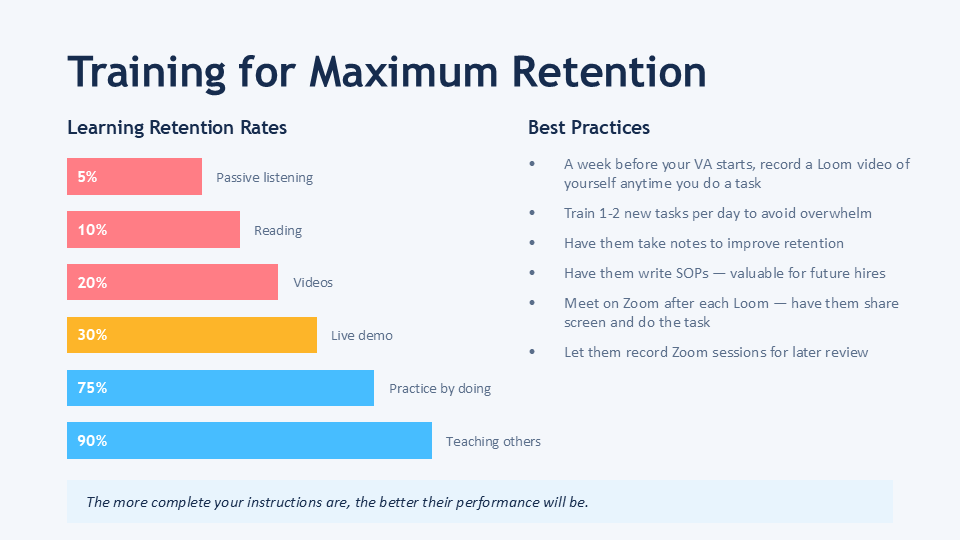
A week before your VA starts, record a Loom of yourself anytime you do a task. Talk as you go, explaining any necessary details.
That’s it.
No SOPs to write. If you really want SOPs later, you can get your VA to make them; it will actually help them learn.
Not all training methods are equally effective.
Watching videos or reading instructions has limited impact. Real learning happens when your VA is actively doing the work.
A practical approach:
Show them how to do the task
Have them do it themselves
Review and correct in real time
If your VA isn’t actively performing the task, progress will be slower than it needs to be.
Use Loom to Capture Your Process
Instead of explaining the same task multiple times, record it once.
Loom allows you to walk through your process while explaining your decisions. This gives your VA context, not just steps.
Over time, these recordings become a library you can reuse for future hires.
This reduces training time and keeps your approach consistent.
Train in Small, Focused Steps
One of the most common mistakes is trying to train too much at once.
A better approach is to introduce:
One or two tasks at a time
Clear expectations for each task
Time to practice before moving on
This keeps your VA from getting overwhelmed and improves retention.
Have Them Take Notes (or Build SOPs)
Encourage your VA to take notes as they learn.
An even better approach is to have them turn those notes into structured SOPs.
This does two things:
Reinforces their understanding
Creates documentation you can reuse
Over time, this becomes a valuable asset for your business.
Use Screen Sharing for Real-Time Training
After your VA watches a Loom video, don’t just assume they understand.
Have them share their screen and complete the task while you watch.
This allows you to:
Catch mistakes early
Clarify misunderstandings
Reinforce the correct process
It’s one of the fastest ways to improve performance.
Encourage Questions Early
A good VA will ask questions.
Make it clear that questions are expected — especially in the early stages.
It’s better to answer a question upfront than fix a mistake later.
Set the Right Pace
Training takes time, especially in the first couple of weeks.
Expect a period of adjustment while your VA learns your workflow and standards.
Rushing this process usually leads to more errors and more time spent fixing them later.
A steady pace leads to better results.
Keep It Structured
Training works best when it’s organized.
At a minimum, you should have:
Loom videos for core tasks
A checklist of what to learn
A place to store SOPs (Notion or Google Sheets)
This keeps everything consistent and makes future training much easier.
Keep It Practical
Training doesn’t need to be complicated.
What matters is:
Clear instructions
Active learning
Consistent feedback
A structured system
When these are in place, your VA will improve quickly — and become more independent over time.
The goal isn’t just to train your VA — it’s to build a system that works for every VA you hire going forward.